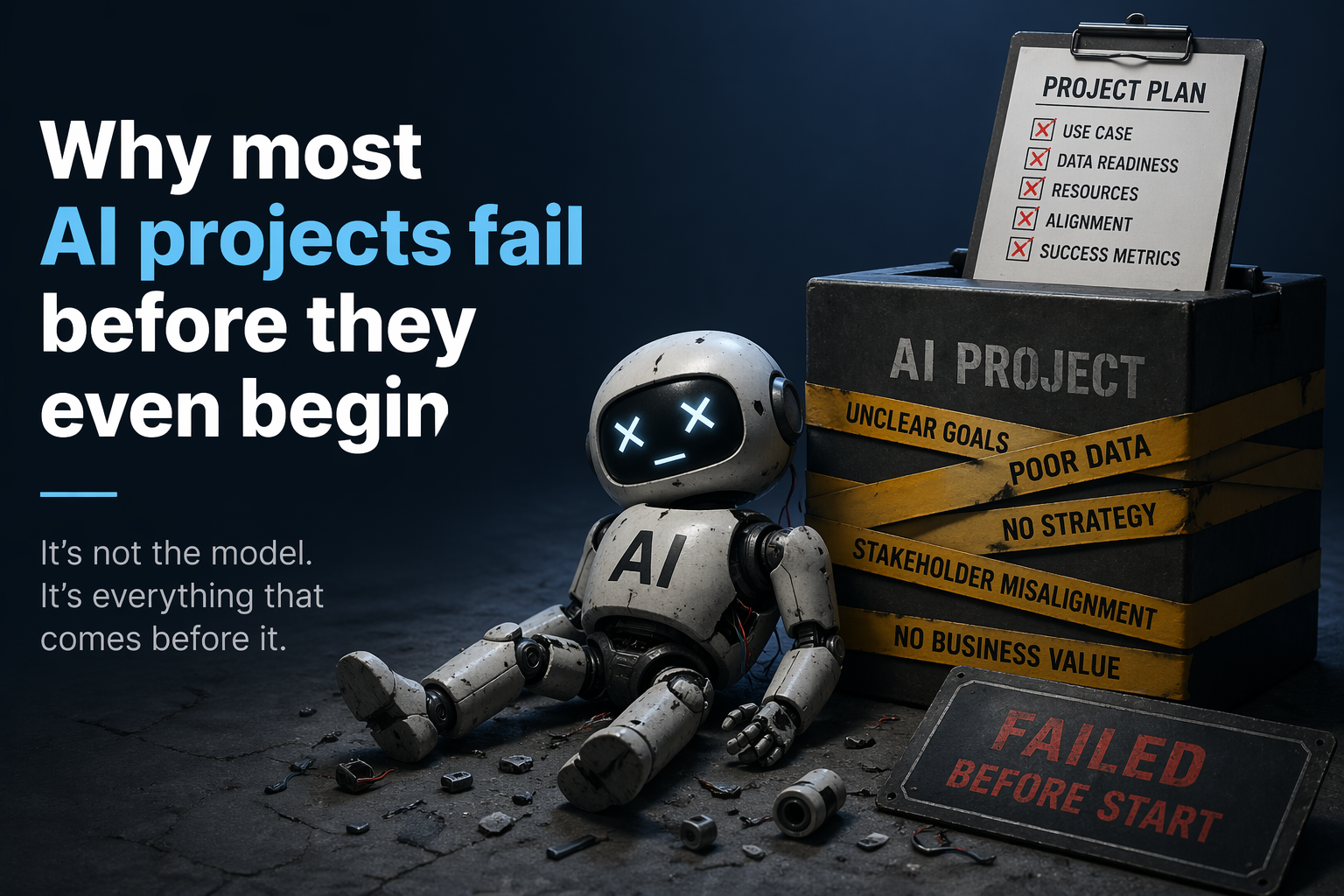
Most AI projects don’t fail during deployment. They fail much earlier often at the very moment they are conceived. There is a familiar pattern here, and it is not unique to AI. It reflects the same issues that have existed in enterprise technology initiatives for years. The difference now is the pace. AI has accelerated decision-making cycles, but it has not improved decision quality.
The urgency driven start

Almost every AI initiative begins with urgency. As new capability emerges like generative AI, predictive analytics, automation and the immediate question becomes: “Can we use this in our processes?” The pressure comes from everywhere: competitors experimenting, boards asking questions, leadership pushing for innovation. The intent is valid, but the starting point is flawed.
The POC illusion
You might have witnessed this same drill – A small group of data scientists or AI specialists is quickly assembled. Within a few weeks, they produce a proof of concept. It works in a controlled environment. The results look promising, sometimes even transformative.

This is where confidence builds and where risk quietly begins to accumulate.. A successful proof of concept creates the illusion of readiness. It suggests that scaling is simply a matter of effort, investment, or time. Organizations move quickly from experimentation to implementation, assuming that what worked in isolation will work within the complexity of the enterprise.
Ignored questions

Unfortunately real-world environments are not controlled environments. The questions that actually determine success are rarely asked at this stage. Is the required data consistently available, accurate, and complete across systems? Are downstream applications capable of consuming and acting on AI-generated outputs? Do existing processes need to be redesigned to incorporate new decision points? Are teams equipped to interpret and trust the results? Are there guardrails in place to manage risk, bias, and unintended consequences?
These are not technical concerns. They are organizational realities. And when they are ignored, the gap between what AI promises and what it delivers begins to widen.
The real problem: Misalignment
At the heart of this problem is misalignment. AI initiatives are often triggered by capability rather than necessity. They are driven by what is possible instead of what is meaningful. This leads to systems being introduced without a clear connection to business outcomes, processes remaining unchanged while technology evolves, and teams being expected to adapt without preparation. Integration becomes an afterthought, and friction emerges across every layer of the organization.

Over time, these issues compound. Models that performed well in isolation struggle in production. Outputs are questioned or ignored. Workflows break or slow down. What began as a high-potential initiative quietly becomes another stalled project.
If we step back, most of these failures can be traced to a lack of foundational readiness. AI does not operate in isolation; it depends on a broader system that must be prepared to support it. This readiness can be understood across four dimensions: data, process, people, and governance.
Readiness Is the difference
Data readiness ensures that the information feeding the system is reliable, consistent, and accessible. Without this, even the most advanced models produce unreliable results. Process readiness recognizes that AI cannot simply be inserted into existing workflows; it requires rethinking how decisions are made and executed. People readiness addresses the human side—ensuring that users understand, trust, and effectively use AI outputs. Governance readiness provides the guardrails, defining how AI is used, monitored, and controlled within the organization.
When any one of these dimensions is weak, scaling becomes difficult. When multiple are weak, failure is almost inevitable.
Wrong starting point

The deeper issue, however, lies in where organizations choose to begin. Most start with the question: “Where can AI be used?” It is an intuitive question, however a better question is: “Where does AI meaningfully improve outcomes and are we ready for it?” This shift forces alignment before action. It prioritizes impact over experimentation.
Proofs of concept are valuable. They demonstrate potential. But they are not proof of readiness. Moving from a successful demonstration to a successful implementation requires a deliberate transition from isolated experiments to integrated systems, from technical validation to organizational alignment.
AI does not fail because the technology is immature. In many cases, the technology works exactly as intended. It fails because the environment it is introduced into is not prepared to support it.
The real challenge isn’t building AI. It’s building the foundation that allows it to work. Until that foundation is in place, most AI initiatives will continue to fail right at the beginning.



Leave a Reply